
No mate, that’s not it
Rod Liddle realised he didn’t like me in less than ninety seconds. He was a genius.

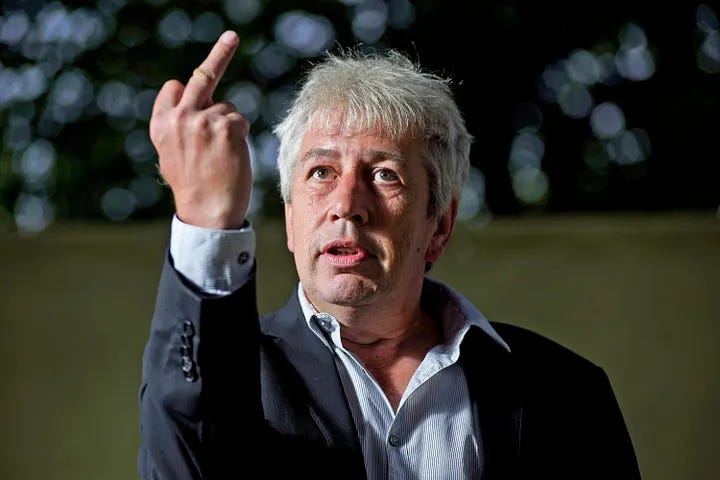
I met Rod Liddle in the late summer of 2018 at a Spectator garden party. He took an instant dislike to me. Swigging white wine from a bottle and chain-smoking, he appeared impressively shit-faced. It was a humid evening and with his shirt untucked and unbuttoned to midway down his chest, hair unkempt, surrounded by a gaggle of delighted fans, he exuded massive rock-star aura.
The party was held in the days immediately after Rod had set off a signature neutron bomb of controversy with a column defending both the brattish behaviour of Serena Williams at the US Open – ‘I have to say I found nothing particularly shocking in her behaviour’ – and the Australian cartoonist Mark Knight, who’d been widely accused of racism by various influential groups for a caricature he’d drawn of the star mid-tantrum, published in the Melbourne Herald Sun.
‘I’ve spent the morning trying to draw a cartoon of a black person without it being racist. It’s bloody difficult. Especially the lips,’ is how the piece started. Cue outcry.
At the time, I had some thoughts of my own about the cultural significance of the Williams incident and wondered if Rod might enjoy discussing them – so I edged my way through the crowd until I was close enough to deliver them. What followed is a bit of a blur. In no particular order, I remember: realising quickly Rod had not in any way taken a shine to me, the word ‘trope’ being said a lot (not by me), a stream of people interrupting us just to shake Rod’s hand and tell him how brilliant he was (he received each with beatific gentleness), and being called ‘mate’ repeatedly in a way that very clearly didn’t signal friendship. ‘No, mate, that’s not it. That’s not it, at all.’ Swig. ‘You just don’t get it, do you, mate?’
I came away from the conversation beyond thrilled. Not only had I spoken to Britain’s – the world’s – best columnist, but he’d been every inch as unpredictable, irascible and memorable as I could have hoped. I hadn’t meant to annoy him. The opposite – I thought he might agree with me, or at least be amused. But he was the great Rod Liddle and if he wanted to give me daggers on account of my well-intentioned nonsense at a prestigious party at which he was very much the guest of honour, then so be it. Who am I to second-guess genius?
I felt shocked and then immensely sad when I heard he had died. Like all Spectator readers, Rod’s was the first column I read in the magazine every Thursday. To my mind, he wasn’t just the voice of a generation. He was the voice of a culture – of the British culture as it is in reality, and not the strange and shiny version of it progressives, metropolitan liberals, corporatists and advertisers would have us believe prevails. His writing was consistently and authentically imbued not only with the British people’s deep distrust for authority and the political class, but also with ancient wisdom, honesty and open-mindedness. Crucially, his writing was – like the British people – profoundly and irreverently funny. It struck me always Rod used humour the way doctors use specula and other intrusive devices, first to locate the wound and then to get the medicine in as deeply as possible.
It’s why the humourless struggled so much with what he had to say, and why, now that he is not able to defend himself, these same people feel emboldened to criticise him publicly by removing funny things he wrote from all context, or by claiming – always without example – that he was guilty of ‘punching down’. It’s a bizarre and ridiculous charge. There was no stauncher or more articulate defender of the beleaguered British working class in the media than Rod Liddle. Anyone who disagrees with this sentiment need only pick up a copy of his book Selfish, Whining Monkeys: How We Ended Up Greedy, Narcissistic and Unhappy. It’s a brilliant piece of writing. They could also, for that matter, read to the end any of the very many columns he wrote for various publications over a quarter of a century.
Truth be told, I’d encountered Rod prior to the Spectator party of 2018. I was on a train from Salisbury to London around 2005 when I realised I was sat across the aisle from him. He was wonderful company – friendly, interested, encouraging – and he told me a very funny story about a time he and Boris Johnson were staying in the same hotel somewhere in Eastern Europe. After one of them had gone to bed – I can’t remember which – he described how the other had rounded up all of the many prostitutes in the lobby and sent them to the sleeping man’s room. ‘Big party, big orgy. Big money. Go now. Go now! Hurry!’ No doubt this is a terribly politically incorrect thing to have done, but Christ it made me laugh to hear him tell it.
Rod’s writing was always accessible – he was incredibly skilful in this regard – but he had the ability to make paper feel heavier just by the weight of the intelligence it contained. The overriding sense of reading him was that of a deeply sensitive and thoughtful man lamenting what as individuals and as a society we are losing in the name of progress, and of modernity.
This is how Selfish, Whining Monkeys (published in 2014) ends:
‘What we have now is a chaos of change, a transience and an impermanence, and a country which has been denuded of those things which bind it together as a whole. We have competing groups, each vociferously proclaiming their sense of victimhood, their grievances. And doing so with such rapidity! The internet and, before it, twenty-four-hour news channels, have given us conduits for the immediate expression of outrage, fury, disappointment – reactions devoid of more than a nanosecond of thought and reflection. That furious yapping you hear is the fugue of our times, a billion dogs furiously chasing their own tails, turning circles in paroxysms of suddenly occasioned anger. Each demanding to be heard. It is not ‘I think therefore I am,’ it is simply ‘I am’ – there is not much in the way of thinking at all. Our narcissism has been partly occasioned, one supposes, as a defence mechanism against a lack of real power over our lives. We demand to be heard because we know that underneath we count for less than we once did.
‘The glue which bound us all together has more or less dissolved, the idea that as a nation state, a territorial entity cohered around a thousand or more years of a common culture, we shared certain values and norms. That seems to have gone, no?
‘Undoubtedly, there are things we do better now: we are more tolerant of diversity, there is far less discrimination against people from ethnic minorities, women, disabled people, homosexuals and those who are transgendered. This, I think, is a good thing. But the moral and political and social upheaval which accompanied this sacking of the old order has left us fraught and clamorous, unhappy, isolated and averse.’
Rest in peace, Rod. You were a giant.